EARTHING AUDITS
Importance of EARTHING AUDITS
Proper electrical earthing is absolutely fundamental for any electrical installation. Its primary purposes are:
- Personnel Safety: protect people from electric shock by providing a safe path for fault currents to flow to the earth.
- Equipment Protection: provide a low-resistance path for fault currents, allowing protective devices (fuses, circuit breakers) to operate on time
- Lightning Protection Integration: An effective earthing system is the final destination for dissipating the massive energy from a lightning strike captured by a Lightning Protection System (LPS).
- Compliance: Meeting mandatory safety standards and regulations (like IS 3043, IEEE standards, CBIP guidelines, and electrical codes).
WHAT SERVICES DO WE OFFER?
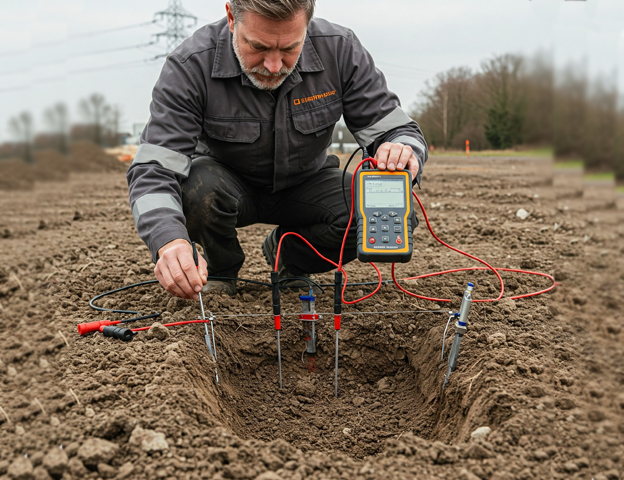
Soil resistivity and Earth pit study
- Determination of the Earthing location
- Complete site assessment and co-ordination with the site team.
- Performance of Soil Resistivity Test with Wenner 4 point Soil resistivity test method
- Calculation of the resistivity at multiple distance and in multiple directions.
- Preparation of the report considering IEEE 80, IEEE 81 and Manual on earthing of AC power system of CBIP Manual.
- Submission of the report along with certificate of calibration of the testing Equipment.
- Arrival of average resistivity values for ease in calculation process for Earthing Design
- Finding resistance of each earth pit and providing the report of same to client.
Earthing Design and Calculation
- Co-ordination with customer for location for making grid and earthing
- Getting master layout in AutoCAD for design of earthing in each structure
- Determination of number of risers for each structure
- Based on the Soil resistivity data, performing calculations of earthing complying with IS-3043.
- Providing the detailed report of the arrived calculation
- Determination of Number of Earth pits, length and size of Grids/Rings and its interconnection methods.
- Designing the earthing system and making the Earthing schedule
- Touch and Step potential measurement and Evaluation
- Verification of Selection and installation of earthing Arrangements
- Safety assessments
- Recommendations and mitigation measures